
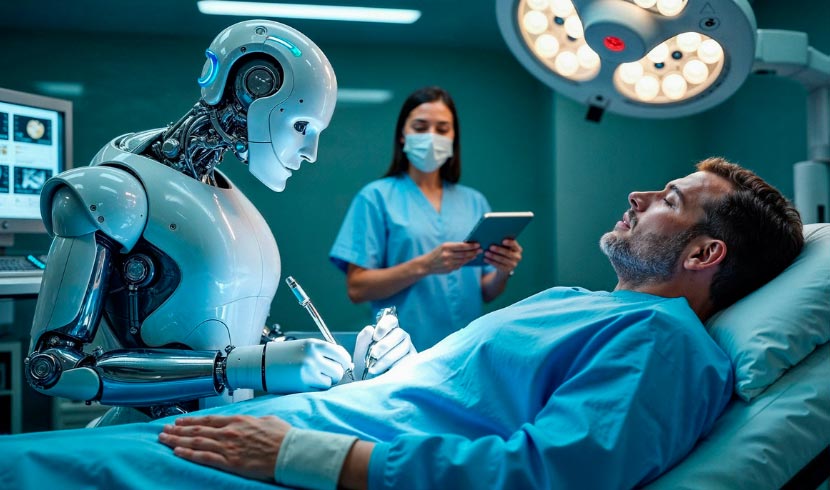

Healthcare has been evolving in so many different ways that you can see significant shifts in hospitals, but it can be difficult to understand exactly how those changes are happening when you look at the outside world. The way that healthcare systems ran on paperwork and manual records and had people making decisions based on their own experience is changing quickly with the introduction of advanced technology solutions capable of processing and analysing vast quantities of medical data nearly instantaneously. The evolution of healthcare extends beyond simple convenience; it will eventually impact the way we provide care, make decisions about the delivery of care, and how patients will experience care overall.
Across the various segments of the health industry, from hospitals to clinics to clinical research, digital tools are now being employed to assist physicians with the diagnosis and treatment plans, as well as the ongoing monitoring of patients. While these systems will never replace physicians, they are intended to help reduce burden, increase accuracy, and ultimately allow for improved clinical judgment in situations where quick decision-making and data analysis are critical.
According to a report from Expert Market Research, hospital healthcare systems around the globe are rapidly implementing digital tools as part of their overall modernization strategies. Nowadays, artificial intelligence is transforming every sector, particularly research and healthcare, while the demand for Artificial Intelligence in the Healthcare Industry continues to grow significantly. Over time, AI has evolved from an experimental technology into an integral and practical component of daily healthcare operations.
A gradual shift in how healthcare systems operate
Artificial intelligence is becoming an integral part of medical care at present and is already set up within health care facilities, including hospitals and even also being utilized in the everyday living environment with wearables, like fitness trackers. The amount of support that AI offers continues to grow, from simply sifting through large amounts of data, to AI systems assisting physicians in making real-time decisions about patient care.
AI offers another significant change to health care, which is how to create and interpret data sets so that health care professionals can simplify and more effectively evaluate thousands of medical records t, to identify patterns that exist, changes in the behaviour of a patient, or determine possible health-related issues associated with patients. The new technologies are enabling health care to transition from a “reactive” form of health care, which is focusing on treating the sickness after it occurs, to a” preventive” form of health care, which places a greater emphasis on identifying potential health risk factors sooner.
Improvements in medical imaging and diagnostic support
AI in medical imaging is a growing field where AI is already playing a significant role. When interpreting complex scans from multiple sources, many radiologists and pathologists use AI-based image interpretation software to identify features that may not be as obvious to human eyes.
From a practical standpoint, AI assists clinicians in identifying early tumor formation, detecting fractures in plain films, and identifying abnormal organs, such as the heart and lungs. AI is also used in large-volume screening initiatives where thousands of scans need to be evaluated quickly.
While AI does not replace physicians’ skills, it provides an extra layer of support by reducing the likelihood of missing subtle abnormalities and freeing radiologists and pathologists to spend more time validating their results rather than performing repetitive reading of scans.
More personalized approaches to treatment
The shift to using patient-specific information along with general treatment guidelines is having a significant impact on creating personalized treatment plans for patients.
The new systems can assess all patient data, including their medical history, gene sequences, lifestyle choices, and how they responded to prior therapy. By using these variables, the systems will provide physicians with information to better predict how an individual patient may respond to a specific treatment.
Microsoft, along with many other healthcare companies, is developing cloud-based healthcare systems that will allow hospitals and healthcare facilities to store and manage patient data more securely and efficiently, thereby facilitating the ability of healthcare professionals to make personalized medical decisions.
Identifying health risks before symptoms appear
Artificial intelligence (AI) can provide many valuable services to healthcare professionals and patients. One of the most important ways that AI can help detect early indicators of illness is by looking for patterns in data rather than waiting until symptoms develop.
For example, identifying risk factors for diseases such as heart disease, diabetes, stroke, and kidney disease is often easier to do when those diseases can be identified earlier. AI technology can assist in this area by analyzing medical history through various types of records, including past, present, and continuous data from wearable devices (e.g., pulse oximeters), which record things like pulse rates, oxygen levels, and sleep durations.
When a person has abnormal data indicating they may be developing a health problem, alerts will be sent to both the patient and the patient’s healthcare provider. This way, an earlier intervention can occur, which improves the likelihood of a better outcome for the patient over the long term and decreases hospital admissions.
Making hospital operations more efficient
The hospitals have a continuous flow of patients and staff working in a restricted operating environment with many administrative functions. AI can reduce the burden on hospitals through improved efficiency by performing many of these standard functions.
For example, throughout the majority of healthcare systems today, AI is being used to schedule appointments, manage medical records, and predict bed availability. While each of these improvements may not appear to be particularly significant on their own, collectively they will reduce the overall operational pressure on hospital staff.
There are companies, such as IBM, that are creating AI-based solutions for the healthcare industry to assist hospitals in improving workflows at the organization level and to help make better decisions at the organization level.
Expanding healthcare access through digital tools
Today’s world offers a multitude of digital health services. No longer do you need to go to the hospital to find out what your health status is or how a particular ailment might affect you. Virtual assistants powered by artificial intelligence can assist individuals with basic medical advice right from their own homes.
Assistance with medication reminders, as well as simple mental health support, is particularly useful in parts of the country where it is difficult to obtain access to healthcare professionals. Although these systems do not replace a physician, they will serve as helpful tools to help fill in the gap between patients and the variety of healthcare services available to them, especially in remote locations or low-income communities.
Speeding up drug research and development
Traditionally, new medication creation is a lengthy, costly process that includes years of study, evaluation, and clinical experimentation. Artificial Intelligence is assisting with shortening this period through the analytical utilization of massive amounts of data and predictive algorithms that simulate the ways different compounds will act in a human being.
By leveraging these advances, the time taken for identifying possible drug candidates, simulating clinical trials, and determining any potential adverse reactions has significantly decreased. AI has provided an example of this assistance by helping to expedite portions of the research process during global health crises in past few years.
Several companies focusing on Technology (such as Google) are adding to the area of medical science; through sophisticated modelling technologies, they are working to assist scientific researchers in being able to accomplish their objectives for developing new treatments for disease biologically faster and/or easier than previously possible.
Healthcare moving closer to home.
With an increase use of remote monitoring devices, another evident change is that more patients can track their key health data from home instead of having to go into a facility frequently.
Remote monitoring technologies, which include wearables and connected health systems, allow patients to continuously monitor blood pressure, heart rate, glucose levels, activity levels and sleep quality.
The use of AI to analyze the data in real time and identify any potential anomalies also adds additional value to this type of health management, as there will be continuous oversight of patients who can live their lives without being interrupted by frequent visits to physician offices; therefor,e allowing elderly and/or those with chronic conditions to receive continued, integrated care through the use of remote monitoring capabilities.
Challenges that need careful attention
Although artificial intelligence (AI) has many advantages when used in healthcare, the disadvantages of AI cannot be overlooked. Privacy and security of patient information are very important challenges as more systems transition from physical records to storing patient records digitally in the cloud. It will be essential to maintain the privacy and security of these records.
The use of incomplete or misbalanced data to train algorithms can lead to algorithmic bias (i.e., the results will not be very accurate). The overall outcome of using algorithms can be affected by the quality of the training data used for the algorithm.
Some AI systems function in a way that may be difficult to explain, causing many healthcare professionals not to understand how an AI determined a conclusion. Therefore, humans must continue to oversee all medical care decisions.
Where healthcare is gradually heading
In the future, the healthcare industry will continue to become more connected with data and will also use automation to improve its ability to prevent illness. We will see AI (artificial intelligence) grow as much as robotics, genomics, and advanced analytical tools, resulting in an integrated system for delivering healthcare.
Predictions include more accurate prediction models of what determines health, greater use of AI-assisted procedures, better access to healthcare for people living in cities away from large bodies of water, and faster response times to public health issues like outbreaks of disease. Many large organizations are making large-scale investments in developing systems to support these advances; for example, such as IBM and Microsoft.
Ultimately, the purpose of using AI is to help healthcare workers perform their jobs better, rather than replacing them. When properly applied, AI should help make healthcare delivery quicker, easier to provide, and focused even more on being able to provide care to individual patients than today.
Read More: How to Build a Secure and Scalable Healthcare App